

When we talk to curious people about the cryopreservation research we do at Until, there’s one question that always comes up:
“So… you freeze people?”
Not quite. We don’t freeze bodies. We’re building controlled-rate freezers, perfusion systems, novel cryoprotectants, and rewarming devices to bring tissue into a temporary glassy state. We vitrify1, rather than freeze, to pause biological time, so that patients can have more time.
At Until, we see reversible cryopreservation as a medical technology. It’s one of these invisible technologies like MRIs and anesthetics and heart stents and defibrillators and dialysis that all quietly exist to enable more of what we love most.
The MRI machine is universally appreciated as a life-saving tool. Most will hope to avoid the need for anesthetics but are widely grateful for their existence. Heart stents, defibrillators, dialysis — we don’t want to need these technologies, but what our species lacks in pristine-perfect health, we make up for in ingenuity, ambition, and care.
We see deep multifaceted beauty in cryopreservation: the technical dance of pausing molecular motion, the social implications for how we approach longevity and death, the cultural container we must evolve for such a technology, and the existential questions it raises about human consciousness, identity, and form. While whole-body medical hibernation is our ultimate goal, numerous fundamental questions must first be answered to de-risk and build our understanding of that goal.
Facets of its beauty are not just in the far off future, they exist right now.
Since 1978, cryopreservation has helped millions of families have children — over 8 million babies have been born via IVF (ESHRE)2. It’s enabled over 1.5 million people to recover from chemotherapy through hematopoietic stem cell transplants, with 84,000 performed each year globally (Haematologica 2022 May)(The Society of Hematologic Oncology).
The next step is larger: preserving complex biological systems like organs.
Researchers like Fahy, who transformed our understanding of how to prevent ice formation during preservation (Fahy 2005); Bischof, whose breakthroughs demonstrated the feasibility of preserving and rewarming complex tissues (Bischof 2025, Manuchehrabadi 2017); Wowk, whose insights into thermal physics helped solve critical cooling and warming challenges (Wowk 2012); and Toner, who pioneered microvascular and subzero preservation strategies for whole rodent organs (Berendsen 2015), have all contributed to the foundations of the field. They’ve shaped the emerging science of large-scale, reversible preservation.
This is where we focus our work. We’re developing scalable core technologies. What succeeds at one scale may fail at another; we don’t yet know which specific approaches will endure. But each step toward larger biological systems reveals the constraints and requirements that shape the next.
Right now, over 100,000 patients are awaiting transplants. 28,000 donated organs are discarded each year in the U.S. alone (UNOS). Reversible cryopreservation could change that. It could extend viable preservation time from hours to weeks, even months, giving patients with end-stage organ disease a real chance at matching, transport, and survival. It could help transition medicine from scarcity to abundance — especially with the use of xeno-donor organs.
Our mission aligns with this near-term future. We aim to help people with end-stage organ disease, build technology to help solve the organ procurement and matching problem, and in doing so, methodically derisk and assess the possibility of whole-body reversible cryopreservation.
Every challenge we solve at the organ scale — cryoprotectant loading, perfusive cooling, nanowarming — teaches us how to navigate the far more complex symphony of the whole human body.
To achieve these goals, we distill our challenge to a single, elegant first principle: pause molecular motion in every organelle, in every cell, in every tissue of a human organ, then resume it.
This deceptively simple problem demands a solution of orchestral beauty and precision. Let’s get into it.
Zoom into the molecular level.
The organ is basically a big bag of proteins, fats, nucleic acids, carbohydrates, and water. We want to save this for later. If we want to save it for meaningfully useful lengths of time, we need to vitrify that water, turn it into a solid glass without the formation of a crystalline ice structure.
First, we need to cool down the organ to stop metabolism and degradation and tissue health decline. This is done all the time in surgery. But there is a limit to how much we can cool; we can’t go below 0°C because ice will nucleate, extend, and the ice crystal structure will pop cells and damage tissues.
As temperature drops, viscosity increases. Below -130°C, all molecular motion stops3. It's like pausing time. At -130°C, water molecules can’t rotate to click into an ice crystal formation. At -60°C, this rotation could take a fraction of a second, but at -130°C, it takes a millennia4. This is where we need to go for long term organ preservation.
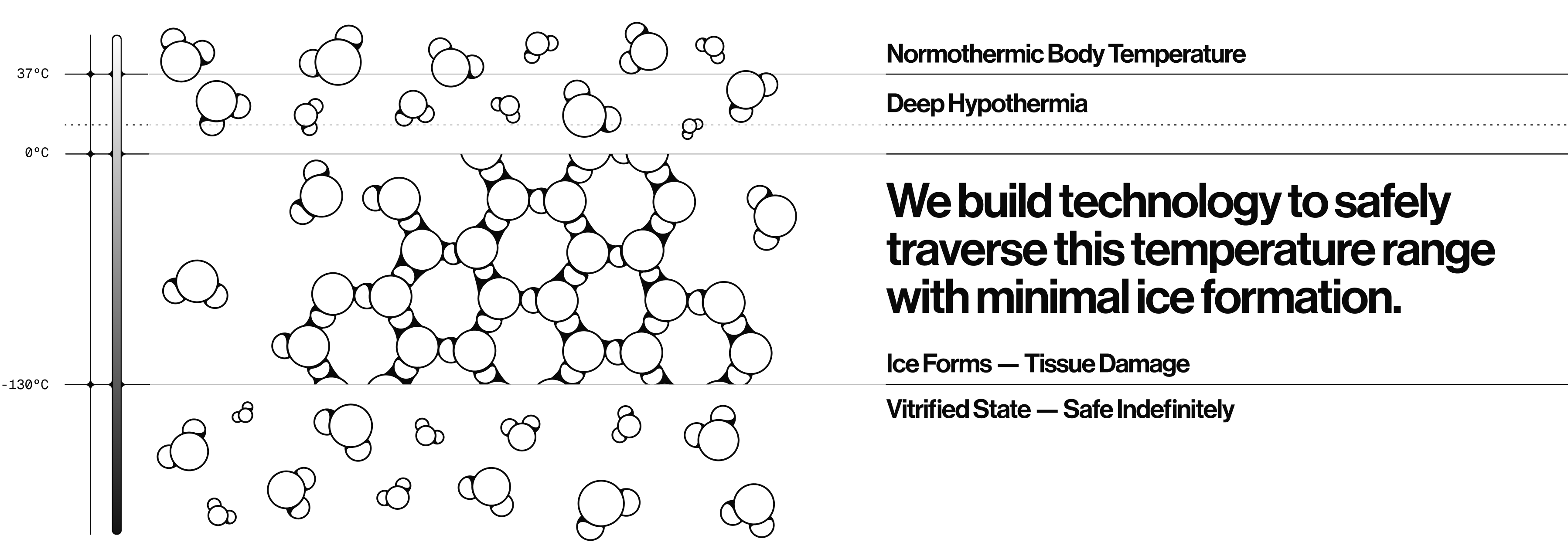
So, if we could snap our fingers and magically bring the organ to -130°C without passing through the ice crystallization danger zone of death, all our problems would be solved, but to get there, we must pass through this danger zone.
Fortunately, we have some tools at our disposal: cryoprotectants.
Cryoprotectants are small molecules that inhibit ice crystal nucleation by disrupting hydrogen bonding between water molecules, increasing viscosity, and lowering the freezing point, often through a combination of these interrelated effects.
But, cryoprotectants are a double-edged sword. To prevent ice formation, the cryoprotectants need to be so highly concentrated that they often end up being toxic to the cells. There are many approaches to avoiding toxicity.
We can find a cryoprotectant that is less toxic, and we can avoid the toxicity by limiting exposure: load the cryoprotectant into the tissue quickly and then vitrify quickly. So, we want to load the cryoprotectants as fast as possible, right?
Wrong! If we load too fast, the cells experience a different type of toxicity: osmotic shock. The cells need time to equilibrate to the cryoprotectant so that water in the cell can slowly be replaced by cryoprotectant, rather than water rapidly diffusing out of the cell due to steep concentration gradients. If the gradient is too extreme, water diffuses too quickly out of the cell and the cell will shrink and die.
The loading rate of cryoprotectants is a delicate ensemble: go fast to avoid cellular toxicity, and go slow to avoid osmotic shock.
It’s possible to find this balance of cryoprotectant loading rate for small volumes. It’s done all the time for embryos and stem cells and blood. We need to find the balance for human organ-sized volumes.
We can use convective cooling,
cooling from the outside in, to vitrify small volumes. Bischof and colleagues have done this for rat kidneys (Han et al 2023)! But as the volume of cells gets larger, thermal gradients inherent to convective cooling cause the tissue to crack. We can prevent cracking by slowing the cooling rate just before the glass transition temperature to allow the volume of tissue to equilibrate. But then, for large volumes, we have to equilibrate for so long that ice forms!
While convective cooling may be sufficient for small volumes, we need an alternative approach to cool larger organs, quickly, and without cracking.
Fortunately organs are, by necessity, very well vascularized. An extensive net of vasculature is how the body gets oxygen and nutrients to cells; no cell lies very far away from a blood vessel. Rather than relying solely on convective cooling, we can use the organ's extensive vascular network as a thermal distribution system, perfusing it with specialized low-viscosity fluids that remain pumpable at extremely low temperatures, enabling faster, more uniform cooling throughout the entire organ.
This approach is called perfusive cooling,
and it represents one of several promising but unresolved challenges in large-scale cryopreservation.
Like an orchestra where each section must play its part with perfect timing and intensity, these technical elements — cryoprotectant toxicity, concentration, loading rates, cooling methods, temperature gradients — must be conducted in precise harmony. One element too dominant or too subtle, and the entire composition fails.
Now if we find this perfect balance, we can slide past the glass transition temperature. Molecules of the tissue are paused in place, nothing will degrade, decay or die. The organ procurement, matching, travel, and transplant process that once operated within a desperate 4-36 hour window can now extend to weeks, months, or even years4. The organ can safely exist in this glassy state while Human Leukocyte Antigen (HLA) matching, crossmatching, and Panel Reactive Antibody (PRA) testing are completed, a perfect recipient is identified, a surgery is scheduled, and the organ leisurely travels to the recipient.
If perfusion is the overture, and reaching glass transition temperature is the climax, glassy existence is the interlude, then rewarming is the grand finale.
Many of the same principles of cooling apply to rewarming the organ. We need to rewarm quickly and homogeneously.
For very small volumes, convective warming (warming from the outside in) works perfectly well. But we probably don’t want to rely completely on convective warming because with large volumes, the outside of the organ will cook while the inside remains cold. There’s too much thermal gradation. We can’t do perfusive warming because the organ is a solid glass. What are other methods of warming?
There's microwave based warming. Microwaves work by exciting polar molecules, like water, causing them to rotate rapidly and generate heat through friction. But as microwave energy travels through tissue, it attenuates. The deeper the wave goes, the weaker it gets. This creates temperature gradients, and gradients equal mechanical stress. Stress leads to cracks, and cracks destroy organs. Is there a wave that can travel through tissue without decreasing in amplitude?
Yes. Low-frequency magnetic fields — specifically in the sub-megahertz range — can penetrate tissue uniformly. These fields can be generated by alternating magnetic field (AMF) coils. Unlike microwaves, they don’t directly excite water molecules. Instead, they interact with materials that have magnetic properties.
Enter: nanoparticles.
These particles might have a magnetic core, coated with a biocompatible shell to stabilize them in solution and prevent aggregation. When perfused through the vasculature of an organ (before vitrification), the nanoparticles are distributed evenly, lodging in capillaries and surrounding tissues.
When it's time to rewarm, we place the organ inside a custom-built AMF coil. The alternating magnetic field causes the magnetic dipoles of each nanoparticle to rapidly realign with the shifting field. But this magnetic flipping is not perfectly efficient. With every reorientation, a bit of energy is lost as heat through two primary mechanisms: Néel relaxation (where the magnetic moment flips within a stationary particle) and Brownian relaxation (where the whole particle rotates physically). This volumetric heat generation rewarms the organ from within, evenly and rapidly, melting the glassy state quickly enough to minimize time spent in the range of temperatures where ice extension could occur.
This approach was elegantly demonstrated in 2023 by Bischof’s group, who successfully rewarmed a vitrified rat kidney using nanoparticles and an AMF coil, preserving tissue architecture and function (Han et al 2023). It was one of the first demonstrations that nanowarming could overcome the limitations of convective and microwave rewarming methods.
Scaling this method up is a major engineering challenge. As the size of the AMF coil increases to accommodate human organs, its magnetic field strength drops. Achieving the necessary field strength for deep, uniform heating of large volumes will require powerful new AMF generators and careful coil design that balances field strength, frequency, and coil size.
There’s one more perilous facet to this grand finale.
Ice nucleation isn’t what kills cells. Ice extension is. Ice can’t extend if it’s never nucleated. In pure water, ice nucleation begins around –38°C. But in biological tissues loaded with cryoprotectants, nucleation can begin much lower and persist all the way down to –100°C. Extension follows at warmer temperatures, peaking around –80°C. If cooling to -130°C is like going through a ring of fire, rewarming is like passing through a torrent of lighter fluid, then going through the ring of fire. The lighter fluid is ice nuclei, the ring of fire is ice extension.
The rewarming rate must be much faster than the cooling rate because the temperature window where ice begins to extend comes after the temperature window where ice begins to nucleate.
Now, if we can carefully orchestrate all our perfusion, cooling, and rewarming instruments through this epic ballad, we've done our job. The organ is rewarmed, the cryoprotectants are gently washed away, and it's ready to be transplanted into the perfectly-matched recipient, set to save a life.
These technical challenges are monumentally complex, but we are up to the challenge and we believe it is worth every effort.
Of the 64,014 organs recovered in the U.S. in 2024, 11,858 never reached patients — often due to logistical constraints rather than medical unsuitability (OPTN)5. The consequences are stark: 70% of donor hearts and 80% of donor lungs go unused, primarily because current preservation methods give transplant teams mere hours to complete the intricate matching and transportation process (University of Washington Medicine, 2023).
Every donated organ that goes unused is a profound loss to the donor, the donor’s family, and the people on the waitlist. Patients wait an average of 5 years for kidneys — 260 weeks tethered to a dialysis machine — while heart and lung patients gamble with survival during their months of waiting. All remain unable to travel, their lives perpetually on hold, hoping for an organ that might arrive too late or never arrive at all.
Reversible cryopreservation can fundamentally change how we procure and match organs, without the constraints of a system built on scarcity rather than abundance.
Cryopreservation has already transformed fertility and cancer care. Now, we’re extending that impact to the organ transplant system and beyond. By developing this technology gently and deliberately, we not only accelerate its arrival but ensure it arrives in the right form. We’re building access: to organ transplants, to future hospitals and cures, and more time with the people we love. That’s the whole point.
Footnotes
1. A misconception about the field of cryo is that we freeze things. Freezing means tiny little crystal ice limbs-of-swords stretching out in three dimensions, crystalline razor spikes that will pop cells and shred the bag. We don’t freeze. We preserve in glass, we vitrify.
2. Although cryopreservation is a cornerstone of modern IVF, not all IVF births rely on frozen eggs or embryos. Fresh embryo transfers are still performed, but the use of frozen embryo transfers (FET) has grown significantly. Between 2017 and 2021, FETs increased by 41% (HFEA UK). Recent data indicates that 79.8% to 86.1% of IVF cycles now use frozen embryos, depending on maternal age (Fertility NJ). Studies suggest that frozen transfers often lead to better outcomes, particularly in high responders (women producing ≥15 eggs), where FET birth rates (52%) surpass fresh transfers (48%) (Duke Health). Additionally, women aged 38-40 see higher live birth rates with frozen transfers (35.7%) compared to fresh (28.4%)(Fertility and Sterility Journal). The shift toward frozen transfers is largely driven by improved cryopreservation techniques and the ability to better synchronize embryo transfer with uterine conditions.
3. The precise temperature at which all molecular motion stops is dependent on various factors including cryoprotectants, pressure, and density. This temperature is known as the glass transition temperature, or Tg. Below the glass transition temperature of a particular molecular environment, water molecules can no longer rotate into the orderly pattern of an ice crystal. The peak ice nucleation temperature for homogeneous water is approximately -38°C, but biological tissues are non-homogeneous systems with various interfaces and impurities that can serve as nucleation sites. These heterogeneities significantly affect ice nucleation dynamics.
4. Current preservation methods limit viability of transplantable organs to very short timeframes after procurement: hearts have 4-6 hours, lungs 4-6 hours, livers 8-12 hours, pancreases 12-24 hours, and kidneys can survive the longest with 24-36 hours (Donor Alliance).
5. You may have noticed that earlier we cited UNOS stating that 28,000 donated organs go unused each year in the U.S. — a number significantly higher than the 11,858 recovered organs that were not transplanted in 2024 (UNOS, OPTN). This difference arises because the 28,000 figure includes organs that were never recovered in the first place. It reflects a broader category: organs from deceased donors who were eligible but whose organs weren’t used, often due to logistical, regulatory, or institutional constraints. In contrast, the 11,858 figure refers specifically to organs that were recovered but not transplanted. There is no simple, unified public record of how many donated organs go unused — especially when it comes to those never recovered. This is partly due to the complexity of definitions and tracking systems, and partly out of concern that publicizing high discard rates without proper context could discourage donation. As a result, the available figures vary depending on how the system defines “donated,” “recovered,” and “transplanted.”
Have something to say?
Email us at